July 2, 2026

Definite integration involving modulus function

Definite  Integration Involving Modulus Function

There is no anti-derivative for a modulus function; however we know it’s definition

\left | x \right |= \left\{\begin{matrix} x\, \, if \, \, x\geq 0\\ -x \, \, otherwise \end{matrix}\right.

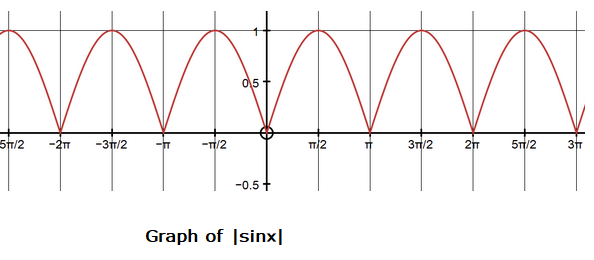
Thus we can split up our integral  in two parts. One  part must be completely negative and the another  must be completely positive. This strategy is known as splitting .  To split correctly it is better to  draw the modulus graph so that we can get the correct equation to represent each portion of the modulus graph .

Example 1 Find the value of \int_{\pi }^{10\pi }\left | sin x \right |dx

 .

Sol.  For a periodic function f(x) with period T\int_{a}^{a+nT}f(x)dx=n\int_{0}^{T}f(x)dx, where n is any natural number.

Here  f(x)=\left | sinx \right |  whose  period  is \pi.

Hence \int_{\pi }^{10\pi }\left | sin x \right |dx=\int_{\pi }^{\pi+9\pi }\left | sin x \right |dx= 9\int_{0}^{\pi}\left | sin x \right | dx

= 9\int_{0}^{\pi }sin x \, dx         (  since sinx \geq 0, \forall \, \, x\in [0,\, \pi ]  )

=9{\left [ -cosx \right]}_{0}^{\pi }   = 9 x 2 =18 .

Thus  \int_{\pi }^{10\pi }\left | sin x \right |dx= 18

graph of |sinx|

Example 2.  Evaluate \int_{-1}^{2}\left | x^{3} -x\right |dx

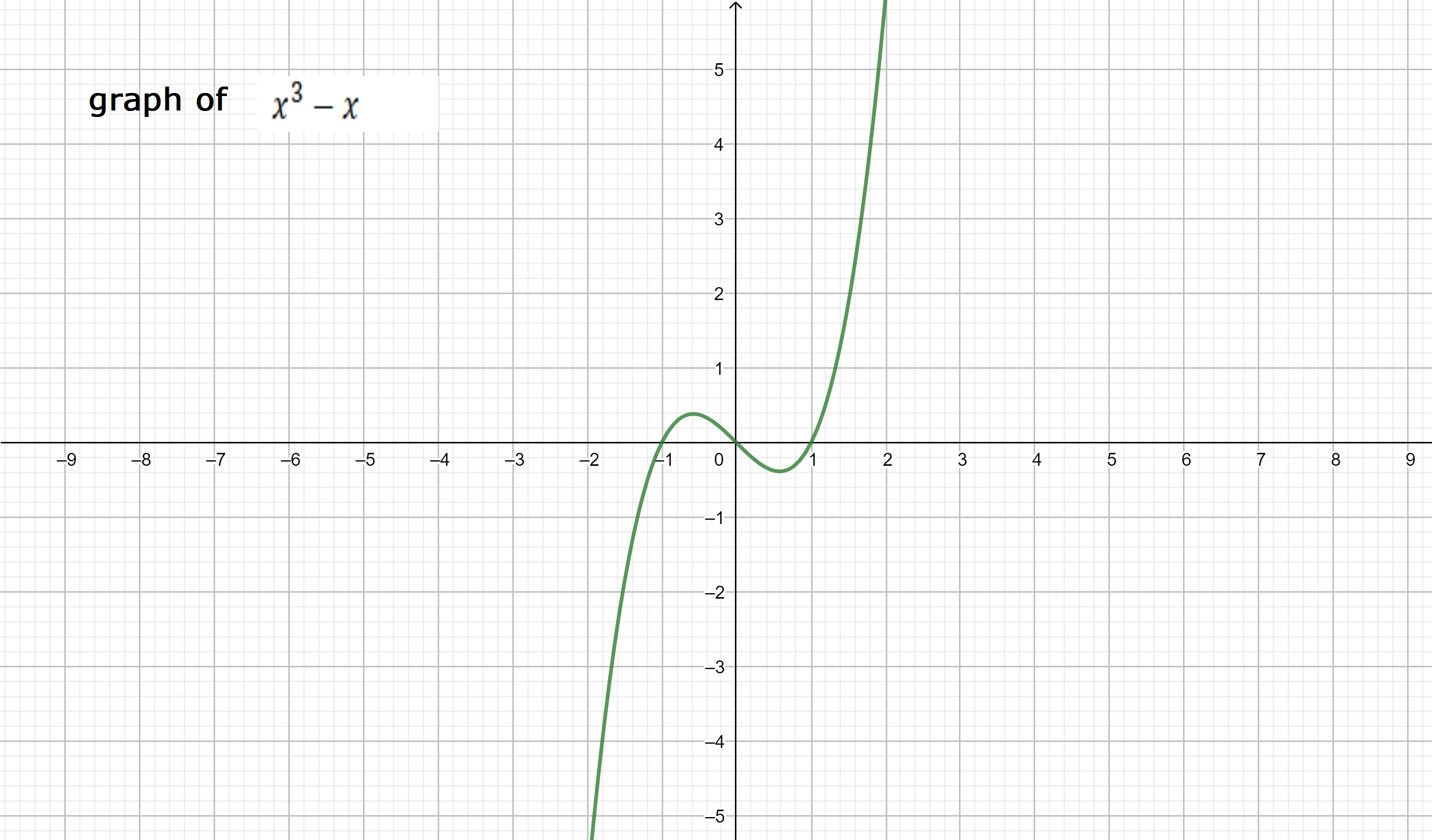
Sol.  We note that x^{3}-x\geq 0 on   \left [ -1, \, 0 \right ] and x^{3}-x\leq 0 on \left [ 0, \, 1\right ]   and that x^{3}-x\geq 0 on \left [ 1, 2 \right ] .

graph 0f x^3−x

Graph of  x^{3}-x

So \int_{-1}^{2}\left |x^{3} -x\right|dx=\int_{-1}^{0}(x^{3}-x)dx+\int_{0}^{1}-(x^{3}-x)dx+\int_{1}^{2}(x^{3}-x)dx

=\int_{-1}^{0}(x^{3}-x)dx+ \int_{0}^{1}(x-x^{3})dx+ \int_{1}^{2}(x^{3}-x)dx

=\left [ \frac{x^{4}}{4}-\frac{x^{2}}{2} \right ]_{-1}^{0}+\left [ \frac{x^{2}}{2}-\frac{x^{4}}{4} \right ]_{0}^{1}+\left [ \frac{x^{4}}{4}-\frac{x^{2}}{2}\right ]_{1}^{2}

= -(\frac{1}{4}-\frac{1}{2})+(\frac{1}{2}-\frac{1}{4})+(4-2)-(\frac{1}{4}-\frac{1}{2})

=\frac{11}{4}

Example 3. Find the value \int_{0}^{\frac{\pi }{2}}\left | cosx-sinx \right |dx

Sol.  We know that  sin\, x   and  cos\, \, x has one common value at x=\frac{\pi }{4}.   In the interval \left [ 0,\, \frac{\pi}{4} \right ] ,   cos\, x\geq sin\, x and in \left [ \frac{\pi }{4} , \, \frac{\pi }{2}\right ]  , sin\, x\geq cos\, x.  Thus  cosx-sinx \geq 0 in \left [ 0,\, \frac{\pi}{4} \right ]  and cosx-sinx \leq 0 in \left [ \frac{\pi }{4} , \, \frac{\pi }{2}\right ].

So \int_{0}^{\frac{\pi }{2}}\left | cosx-sinx \right |dx=\int_{0}^{\frac{\pi }{4}}\left ( cosx-sinx \right )dx+\int_{\frac{\pi }{4}}^{\frac{\pi }{2}}-\left ( cosx-sinx \right )dx

=[sin\, x+cos\, x]_{0}^{\frac{\pi }{4}}+[-cos\, x -sin\, x]_{\frac{\pi }{4}}^{\frac{\pi }{2}}

=(\frac{1}{\sqrt{2}}+\frac{1}{\sqrt{2}}-1)+\left \{- 1-(-\frac{1}{\sqrt{2}} -\frac{1}{\sqrt{2}})\right\}

=2\sqrt{2}-2

https://youtu.be/EAYq3ySAy9k

Leave a Reply

Your email address will not be published. Required fields are marked *

Some tips for mathematics students Scholarships for Girl Students in India How to improve your maths grades How you can avoid silly mistakes in Mathematics How to prepare for NDA Maths Exam