
 by
by
Addition of Integers: Complete Guide with Rules, Examples, and Practice
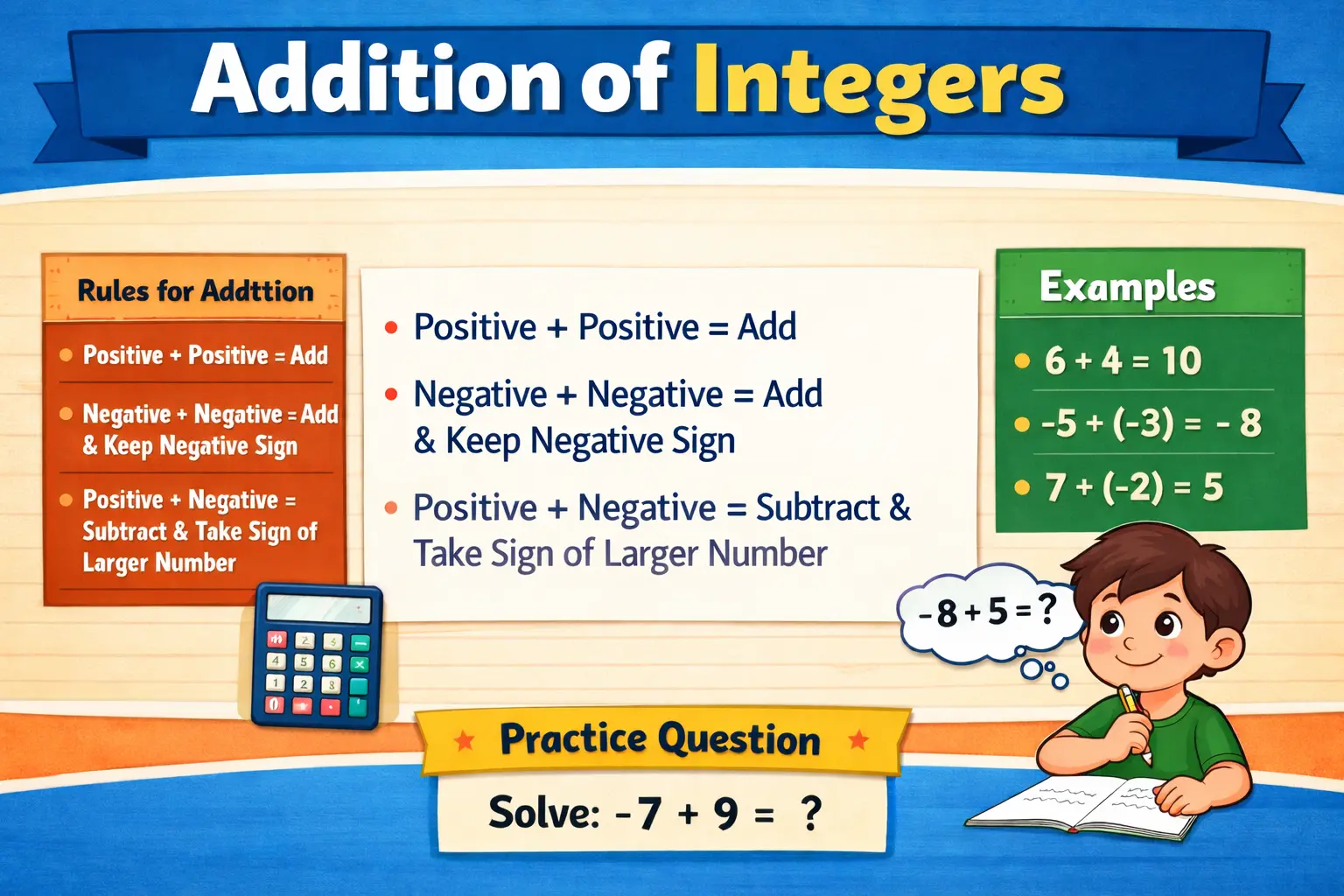
Mathematics becomes easier when we clearly understand basic concepts. One important concept in math is Addition of Integers. Students learn this topic in middle school, and it is essential for solving many advanced math problems.
In this detailed guide, you will learn what integers are, the rules for adding them, examples, real-life applications, and practice questions to strengthen your understanding.
What Are Integers?
Before learning addition, we must first understand integers.
Integers are whole numbers that can be positive, negative, or zero.
Examples of integers:
-
Positive integers: 1, 2, 3, 10
-
Negative integers: –1, –2, –5, –20
-
Zero: 0
Integers are used in many real-life situations such as temperatures, financial transactions, elevations, and scores.
For example:
-
Temperature can be –5°C in winter.
-
A bank balance may show –₹200 if money is owed.
What is the Addition of Integers?
Addition of integers means combining two or more integers to find their total value.
Examples:
-
4+3=74+3=7
-
−6+(−2)=−8−6+(−2)=−8
-
9+(−4)=59+(−4)=5
When adding integers, the sign of the numbers plays a very important role.
Rules for Adding Integers
To solve integer addition problems correctly, follow these important rules.
1️⃣ Adding Two Positive Integers
When both integers are positive, simply add them normally.
Example:
7+5=127+5=12
Here both numbers are positive, so we add them directly.
2️⃣ Adding Two Negative Integers
When both integers are negative, add the numbers and keep the negative sign.
Example:
−6+(−4)=−10−6+(−4)=−10
Steps:
-
Add the numbers: 6 + 4 = 10
-
Keep the negative sign
Result: –10
3️⃣ Adding One Positive and One Negative Integer
When one integer is positive and the other is negative:
-
Subtract the smaller number from the larger number.
-
Keep the sign of the number with the larger value.
Example 1:
8+(−3)=58+(−3)=5
Example 2:
−9+4=−5−9+4=−5
In the second example, the negative number has a greater value, so the result is negative.
Understanding Integer Addition Using the Number Line
A number line is one of the easiest ways to visualize integer addition.
Steps to Use a Number Line
-
Start at the first number.
-
Move right if the second number is positive.
-
Move left if the second number is negative.
Example:
3+(−5)3+(−5)
Steps:
-
Start at 3
-
Move 5 steps left
-
You reach –2
So the answer is –2.
The number line helps students understand how positive and negative numbers behave.
Properties of Integer Addition
Integer addition follows some important mathematical properties.
1️⃣ Commutative Property
Changing the order of numbers does not change the result.
Example:
4+6=6+44+6=6+4
Both give 10.
2️⃣ Associative Property
Grouping of numbers does not change the result.
Example:
(2+3)+4=2+(3+4)(2+3)+4=2+(3+4)
Both give 9.
3️⃣ Identity Property
Adding 0 to any integer does not change its value.
Example:
8+0=88+0=8
Real-Life Examples of Integer Addition
Integer addition is used in many real-life situations.
1️⃣ Temperature Changes
Suppose the temperature is –4°C and it rises by 7°C.
Calculation:
−4+7=3−4+7=3
New temperature = 3°C
2️⃣ Bank Transactions
If you owe ₹10 and receive ₹15, your new balance becomes:
−10+15=5−10+15=5
Balance = ₹5
3️⃣ Elevation
A diver is –20 meters below sea level and swims up 12 meters.
Calculation:
−20+12=−8−20+12=−8
The diver is now –8 meters below sea level.
Common Mistakes Students Make
When learning integer addition, students often make these mistakes:
❌ Ignoring Signs
Example mistake:
−5+3=−8−5+3=−8
Correct answer:
−5+3=−2−5+3=−2
❌ Adding Instead of Subtracting
Example mistake:
7+(−4)=117+(−4)=11
Correct answer:
7+(−4)=37+(−4)=3
❌ Confusing Positive and Negative Values
Always compare numbers carefully when signs are different.
Practice Questions
Try solving these questions yourself.
-
−6+9=?−6+9=?
-
−8+(−7)=?−8+(−7)=?
-
12+(−5)=?12+(−5)=?
-
−15+10=?−15+10=?
-
−4+(−9)=?−4+(−9)=?
Answers
-
3
-
–15
-
7
-
–5
-
–13
Practicing regularly will improve your confidence in solving integer problems.
Why Learning Integer Addition is Important
Understanding integer addition is important because it:
-
Builds a strong foundation in mathematics
-
Helps solve algebra and higher-level math problems
-
Improves logical thinking
-
Is used in real-life calculations
Students who master integer operations find later math topics much easier.
Tips to Master Integer Addition
Here are some helpful tips:
✔ Always check the signs of numbers
✔ Practice using a Number Line
✔ Solve many practice problems
✔ Remember the three main rules of integer addition
With practice, integer addition becomes very easy.
Conclusion
The Addition of Integers is a fundamental mathematical concept that every student should understand. By learning the rules, practicing examples, and using tools like the Number Line, students can quickly master this topic.
- Whether you are solving math problems, calculating temperatures, or understanding financial transactions, integers play an important role in everyday life.
Regular practice and clear understanding will help you become confident in working with Integers
INTEGERS PRACTICE QUIZ
You might also be interested in:
- BODMAS Questions for class 5
- Simplify questions for class
- Division sums for class 5
- Unitary Method for Class 5
