July 23, 2026

Set Theory(NCERT Exemplar )

Here we have given the solutions of  some important questions of chapter 1 (Set Theory) of NCERT Exemplar book .

Short answer type questions

1. Write the following sets in the roaster  form

(i) \large A=\left \{ x: x\in \mathbb{R}, 2x+11=15 \right \}

(ii)\large B=\left \{ x|x^{2} =x, x\in \mathbb{R}\right \}

(iii) \large C=\left \{ x|x \, is \, a\, positive \, factor \, of\, a\, prime\, number\, p \right \}

Sol. (i) On solving the equation     \large 2x+11=15 , we get 

\large 2x=4 \Rightarrow x=2

Thus     A=\left \{ 2 \right \}.

(ii)      \large x^{2}=x  gives  \large x(x-1)=0  which implies \large x=0, 1

Thus B=\left \{ 0,1 \right \}

(iii) Since every prime no. has  only two factors 1 and number itself. This implies

       \large C=\left \{ 1,p \right \}

2.  Write the following sets in the roaster  form:

(i)  \large D=\left \{ t|t^{3}=t, t\in \mathbb{R} \right \}

(ii) E=\left \{ w|\frac{w-2}{w+3} =3, w\in \mathbb{R}\right \}

(iii) F=\left \{ x|x^{4}-5x^{2}+6=0, x\in \mathbb{R} \right \}

Sol. (i) On solving   t^{3}=t, we get     t(t^{2}-1)=0,  which implies  either t=0 or  t^{2}-1=0.

\Rightarrow t=-1,0,+1

Thus D=\left \{ -1,0,+1 \right \}

(ii)           \frac{w-2}{w+3}=3     implies

w-2=3w+9

It gives  w=-\frac{11}{2}.

Thus E= \left \{-\frac{11}{2} \right \}.

(iii)   We have  x^{4}-5x^{2}+6=0

This implies      x^{4}-3x^{2}-2x^{2}+6=0\Rightarrow (x^{2}-3)(x^{2}-2)=0 \Rightarrow x=\pm \sqrt{3}, \pm \sqrt{2}.

Therefore  F=\left \{ -\sqrt{3},-\sqrt{2},\sqrt{2} ,\sqrt{3}\right \}.

Q3. If Y = \left \{ x: x \, is \, a \, positive \, factor \, of \, the \, number\, 2^{p-1}\left(2^{p}-1\right),\, where\, 2^{p} - 1 \, is \, a \, prime \, number\right \}. Write Y in the roaster form.

sol. Y = \left \{ x: x \, is \, a \, positive \, factor \, of \, the \, number\, 2^{p-1}\left(2^{p}-1\right),\, where\, 2^{p} - 1 \, is \, a \, prime \, number\right \}.

Since 2^{p}-1  is prime number , it has only two factors 1 and ( 2^{p}-1) and  the factors of 2^{p-1} are 1,2,22,23,…,2^{p-1} .   Therefore Y= \left\{1,2,2^{2},2^{3},.....,2^{p-1},2^{p}-1\right \}.

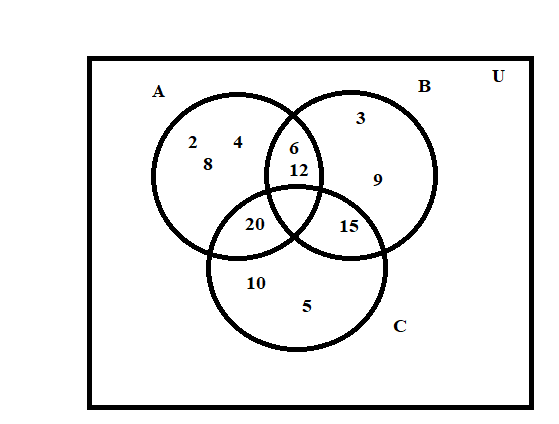
Q4. A, B   and C are subsets of Universal Set U.  IfA = \left \{2, 4, 6, 8, 12, 20 \right \}, B= \left \{3,6,9,12,15\right \}, C= \left \{5,10,15,20 \right \}  and U is the set of all whole numbers, draw a Venn diagram showing the relation of U, A, B and C.

Sol. Here  A = \left \{2, 4, 6, 8, 12, 20 \right \}, B= \left \{3,6,9,12,15\right \}, C= \left \{5,10,15,20 \right \}

Therefore A\cap B=\left \{ 6,12 \right \}, B\cap C=\left \{ 15 \right \}A\cap C=\left \{ 20 \right \} and A\cap B\cap C=\phi.

Hence, the Venn diagram showing relation of given sets is:
                                                   

5. Determine whether  the statement given below   is true or false. Justify your answer.

For all sets A, B and C, A - \left ( B - C \right ) = (A - B) - C

Solution:  Let A = \left \{2, 4, 6, 8, 12, 20 \right \}, B= \left \{3,6,9,12,15\right \}, C= \left \{5,10,15,20 \right \},

then  B-C=\left \{ 3,6,9,12 \right \}. This implies  A-\left ( B-C \right )=\left \{ 2, 4,8,20 \right \}             …………..(i)

Now A-B=\left \{ 2,4,8,20 \right \}, this implies  \left ( A-B \right )-C=\left \{ 2,4,8 \right \}                    …………..(ii)

From (i) and (ii) , it is clear that A - \left ( B - C \right ) \neq (A - B) - C.

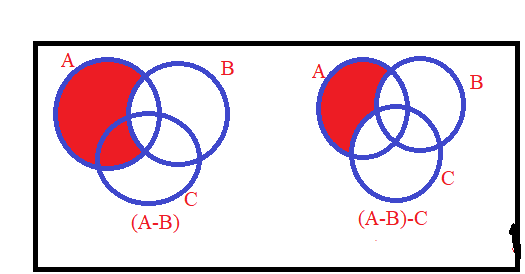
We can also show that the given expression is false by using Venn Diagrams
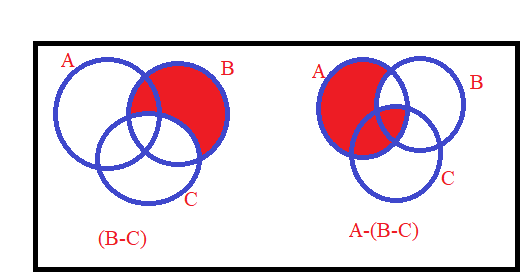
Now, from the Venn diagrams,  it is clear that A - \left ( B - C \right ) \neq (A - B) - C.


Leave a Reply

Your email address will not be published. Required fields are marked *

Some tips for mathematics students Scholarships for Girl Students in India How to improve your maths grades How you can avoid silly mistakes in Mathematics How to prepare for NDA Maths Exam